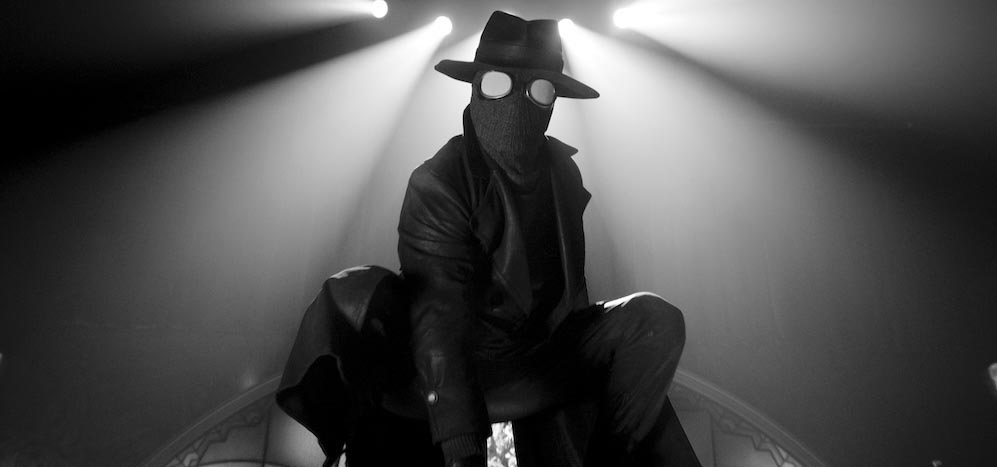
Film noir often features rain-slick streets, strong lighting, venetian blinds, and a detective who trusts nobody. Adding spiders and dream sequences to that mix turned out to be a lot of fun.
In Spider-Noir, Nick Cage stars as Ben Reilly, an aging and down on his luck private investigator in 1930s New York, who is forced to grapple with his past life as the city’s one and only superhero. Cinesite’s 130 visual effects shots for the 8-episode series spanned creatures, environments, action shots and devising visual approaches for a suspenseful, almost entirely CG dream sequence. Work across five episodes was overseen by VFX supervisor Suzie Askham, working closely with studio VFX supervisor Hnedel Maximore and VFX producer Brooke Noska.
Spider Design and Movement
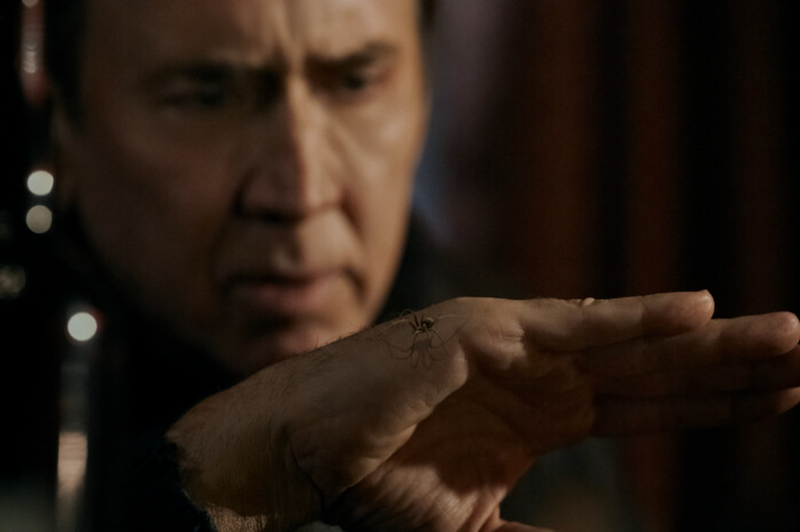 As viewers might expect, spiders are an important element of Spider-Noir.
In shots set in Reilly’s office, as he reflects on his strange affinity with spiders, we see one crawling across his desk and at one point being picked up and examined on the back of his hand. Cinesite was tasked with adding spiders at various points throughout the series.
The client favoured the look of Brown Recluses, small spiders with leg spans no greater than 1 inch. The creature was built in CG using reference both supplied by the production and researched by the modelling team. Some features were exaggerated for the screen; the CG recluse was slightly furrier and more long-legged than the actual spider. The movement and behaviour of the real spider was carefully matched using key frame animation, with its distinctive slow movement when idling accelerating to sudden speed when hunting.
Hallucination and Spider Transformation
In one key sequence, after Reilly has been drugged and is strapped down in a laboratory on a gurney, he begins to hallucinate.
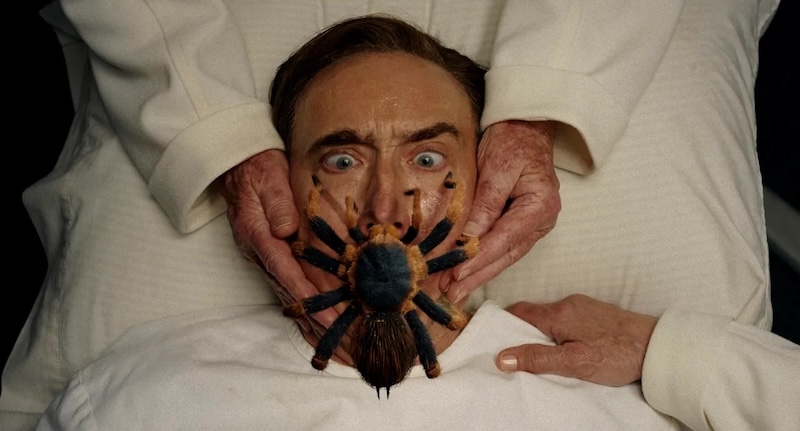
The oxygen mask covering his face turns into a huge tarantula and as a surgeon cuts into him, instead of blood, a mass of tiny spiders radiates out from the wound, streaming over his torso, onto the gurney and repelling from spider webs down onto the floor. Reilly screams in terror, throwing the spider covering his face to the ground.
This sequence formed Cinesite’s most challenging work. In developing the initial oxygen mask spider, the Recluse was considered, as was the Black Widow, but ultimately, a Columbian Red Kneed Tarantula was decided upon, primarily for its size and hairiness. Tarantulas were also initially considered for the spiders streaming out of the wound, but Brown Recluses worked best, giving an almost liquid sense as they flow over Reilly’s torso.
Spider movement was complex to achieve, due to their numbers, and the complexity of their interaction with each other, Reilly’s body, skin and the cloth of his hospital gown. The process involved the challenge of match-moving the actor, thrashing around the bed, creating an animated shot sculpt for fine details, and using effects animation for the mass of spiders, with bespoke movements meticulously animated, key frame by key frame.
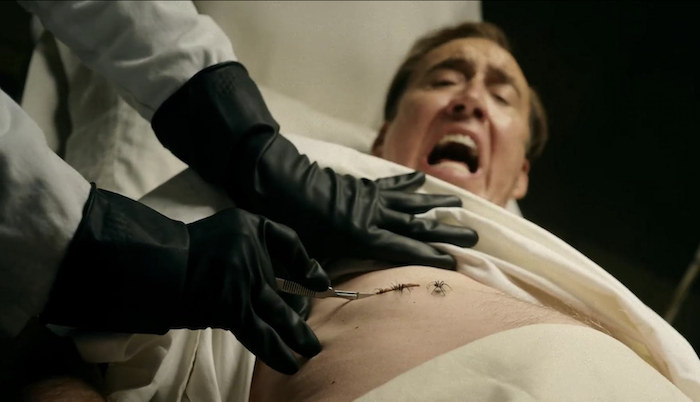
“Those bespoke and nuanced movements were really important. For example, as the spiders crawl out of the wound on Reilly’s stomach, we added realistic searching movements, where the spiders are reaching out, over the edge, feeling their way up onto his body.”
– Suzie Askham
The camera pans down from the bed with the spiders cascading, casting webs from the gurney to the floor and repelling down. This visual was inspired by ants building bridges and using their bodies collaboratively to bridge gaps. The highlights in the webs were exaggerated to make them visible against the dark environment, and viscous in an almost blood-like way.
Dream Sequence
After the laboratory hallucination, we transition through the eye of a Spider mask, a refracted hexagonal, kaleidoscope view, into a dream sequence where Reilly revisits people, places and memories from a miniature, spider’s perspective. Actor Nick Cage was filmed almost entirely against bluescreen or running on a treadmill, with Cinesite devising and creating all of the surrounding action.
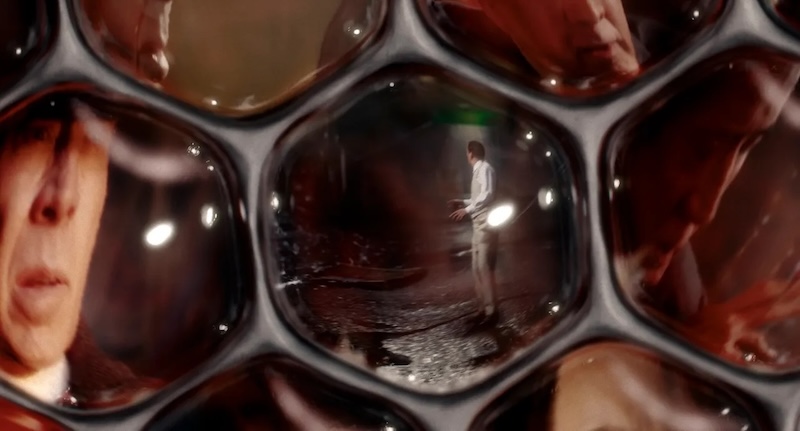
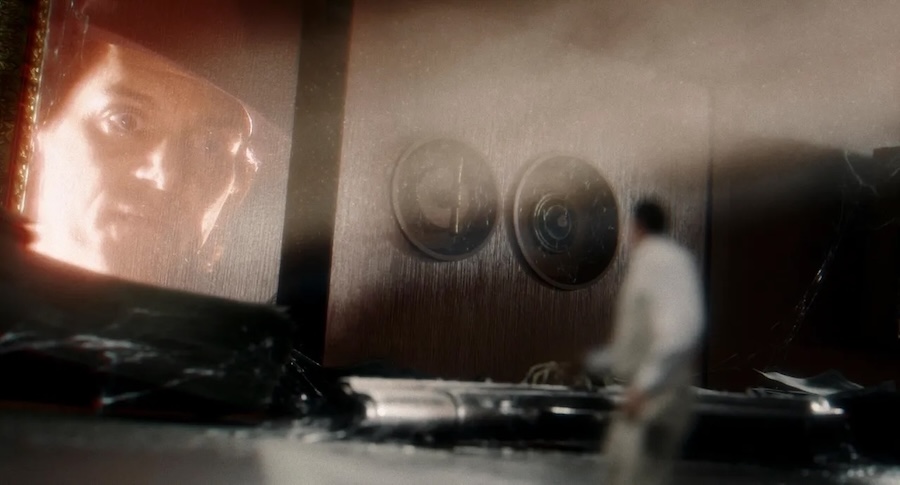
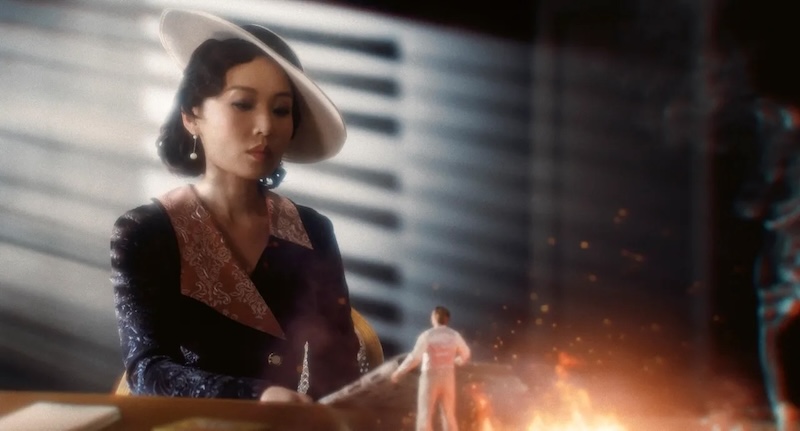
The following dream sequence had not been storyboarded, so VFX supervisor Suzie worked with CG supervisor Gee Tatchell and layout artists to visualise the 12 shot sequence, to pin down the look with the client. As a small man in a big world, the miniature Reilly transitions through memories of different people, and the surrounding environments change to reflect them. Oversized CG environments were created, starting with Reilly walking on a desk past money and a gun, then on a bar past a whiskey glass, ash-tray and other paraphernalia, before the ground becomes a road and a running, terrified Reilly is confronted by a terrifying vision of a burning person at an oil field. This sequence of shots required the creation of a digidouble without the use of 3D scans, only photography, and the addition of CG fire to match a previous sequence in the series. All of this dream action was created with a cinematic approach and in a Film Noir style, with reflections, refractions and Dutch angles.
Hall of Mirrors
A later episode in the series features bad guy Silvermane walking through a hall of mirrors and having a standoff with another character, with bullets striking the mirrors which break like safety glass, gradually weakening as the tension builds before they finally shatter.
This sequence was heavily influenced by The Lady from Shanghai (1947), with the team aiming for a modern version of the famous Hall of Mirrors scene. The actors were filmed against mirrors, and the team combined multiple plates and performances to create the illusion of a single environment, with the visual effects adding bullet cracks and shattering. For budget reasons, a 2D mirror cracking solution was developed – physical smashed glass elements combined with hand-painted cracking. This 2D workflow allowed for art direction of each crack placement and a highly flexible approach.
Undercover Visual Effects
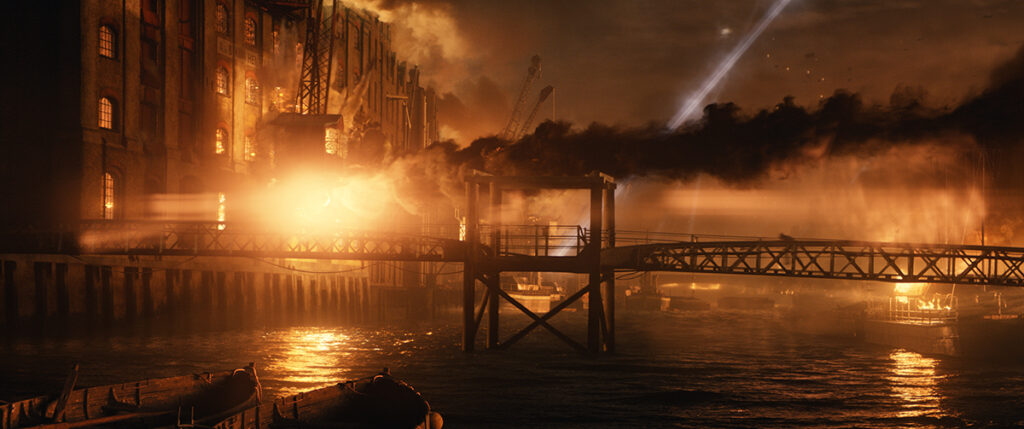
A wide range of other work was required, much of which involved the creation of almost entirely CG environments, or extending and adjusting shots filmed in LA to make them appear like 1930s New York.
The inner workings of a lock were created for a lock-picking scene, and a microscopic view of Reilly’s unnatural blood seen through a microscope were entirely computer generated shots.
All of the visual effects were delivered in two ways, to support the premise that audiences choose how to watch – in “authentic” black and white and “True Hue” full colour.
Spider-Noir premiered in May 2026 on MGM+ in the US and globally on Prime Video from May 27.