Cinesite channelled the power of Grayskull to deliver visual effects for Masters of the Universe, under the guidance of studio VFX supervisor David Vickery.
Our contribution centred on two main sequences, in addition to a few other stand-out moments; the explosive “Hallway Battle” and the dark, atmospheric “Skeletor’s Boudoir.” Cinesite’s work was overseen by in-house VFX supervisor Christian Irles.
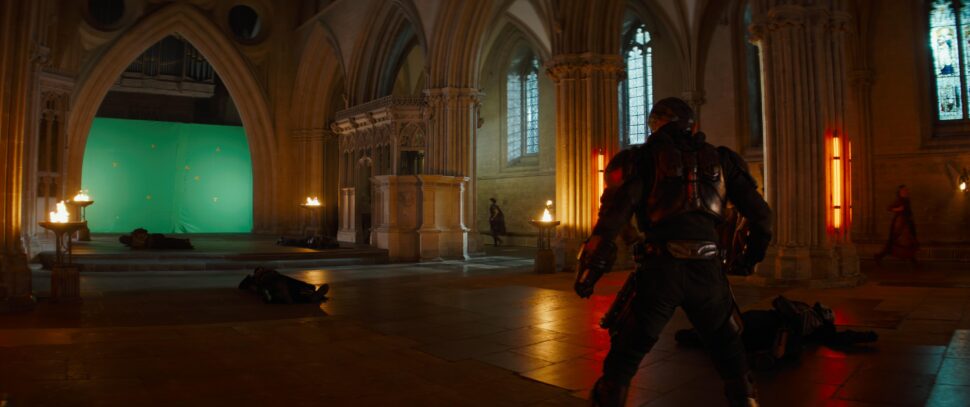
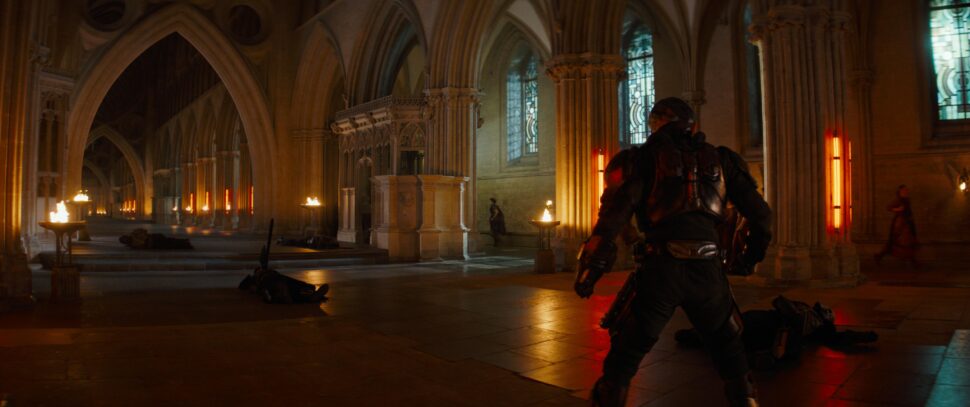
In the Hallway Battle, Duncan (Man-at-Arms) is attempting to extract the royal family from Eternos Palace under heavy assault by Skeletor’s army, culminating in a brutal, hand-to-hand clash with the iconic cyborg villain, Trap Jaw. The fight spans two environments, the first of which was captured in the UK’s Wells Cathedral. To elevate the scale of the real-world location, Cinesite digitally extended the back of the building to grander proportions, as well as replacing the stained-glass windows with custom digital designs steeped in He-Man folklore provided by the production’s art department.
For the latter part of the corridor battle sequence, the stage had no roof to enable high practical lighting rigs, but also to be able to light the set in a way in which it felt there was damage to the roof due to the ongoing battle (essentially big holes in the roof) letting blue moon light in. Cinesite generated 2D concepts, taking direct cues from the physical set and from Wells Cathedral, to match the exact brick colours and textures, subsequently modeling a 3D vaulted, battle-damaged ceiling. Compositing was a tricky process, as plates for each shot featured shifting levels of atmospheric practical smoke and dust which required meticulous 2D integration.
Within this extended environment Trap Jaw, played by Sam C. Wilson, attacks Duncan, leaping high above him in a savage and destructive brawl. Wilson’s performance was roto-animated, focusing heavily on his arm movement (painted chroma-key green).
Director Travis Knight wanted to push the intensity of Trap Jaw’s slow motion leap, so a digi-double was ultimately used, replacing the character entirely digitally.
ILM, lead vendors for Trap Jaw, had supplied Cinesite with a full body digi double, which was a very good starting point. Seen in extreme close up in this shot and others throughout the sequence, it was necessary to increase resolution and detail in the textures and lookdev, to make sure it would hold up to close scrutiny. The character wears extensive armour across his body and it was also important for our CG arm to match seamlessly into it, particularly in terms of lighting.
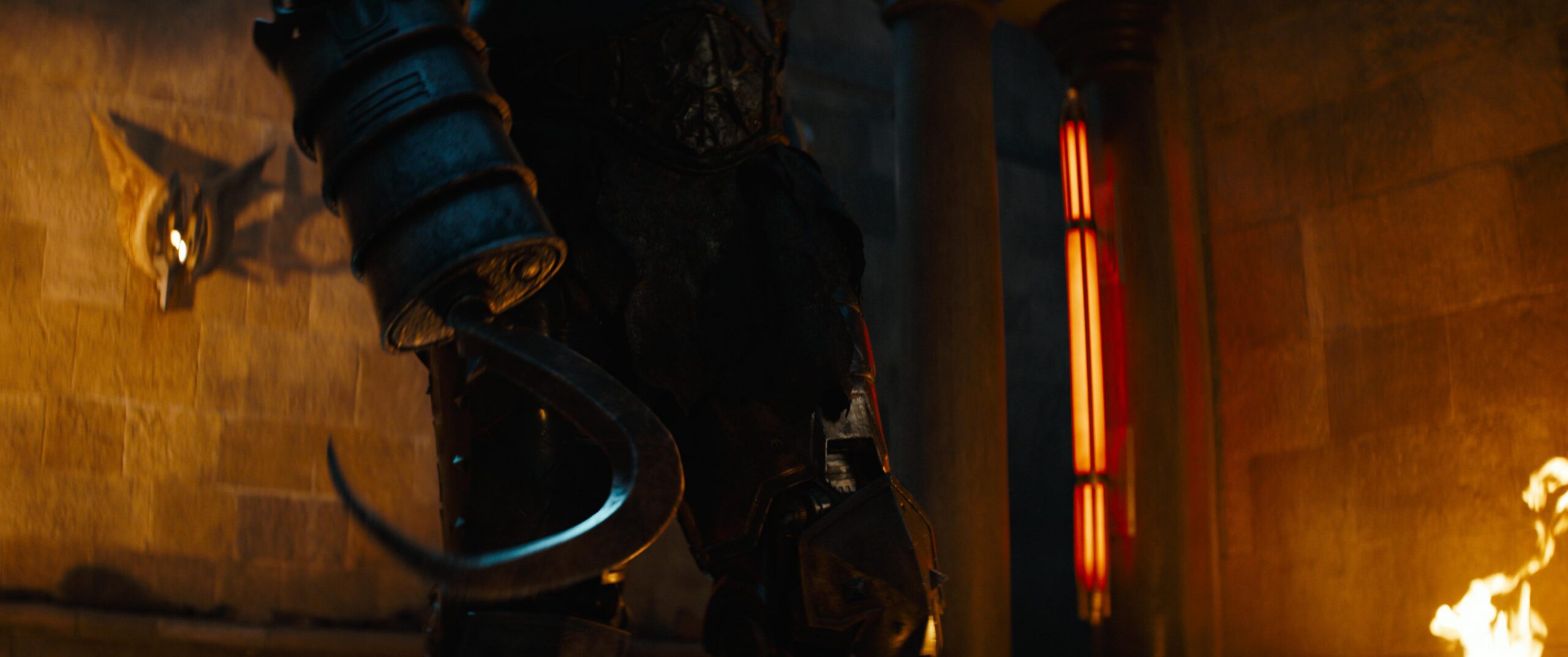 Trap Jaw’s mechanical arm is a three-stage modular weapon – hook, blade and gauntlet. The mechanical transitions between these weapons required some subtle cheating of physics. Referencing approaches supplied by ILM, the team designed revolving internal pieces so that components could seamlessly disappear into the base during weapon rotations, maintaining structural plausibility without feeling magical.
To embed the conflict naturally into the environment, Cinesite generated an array of blaster impacts, sparks, and debris. The resulting “Battle FX” were so well-received that the client utilized them as a creative blueprint for the film’s other VFX vendors.
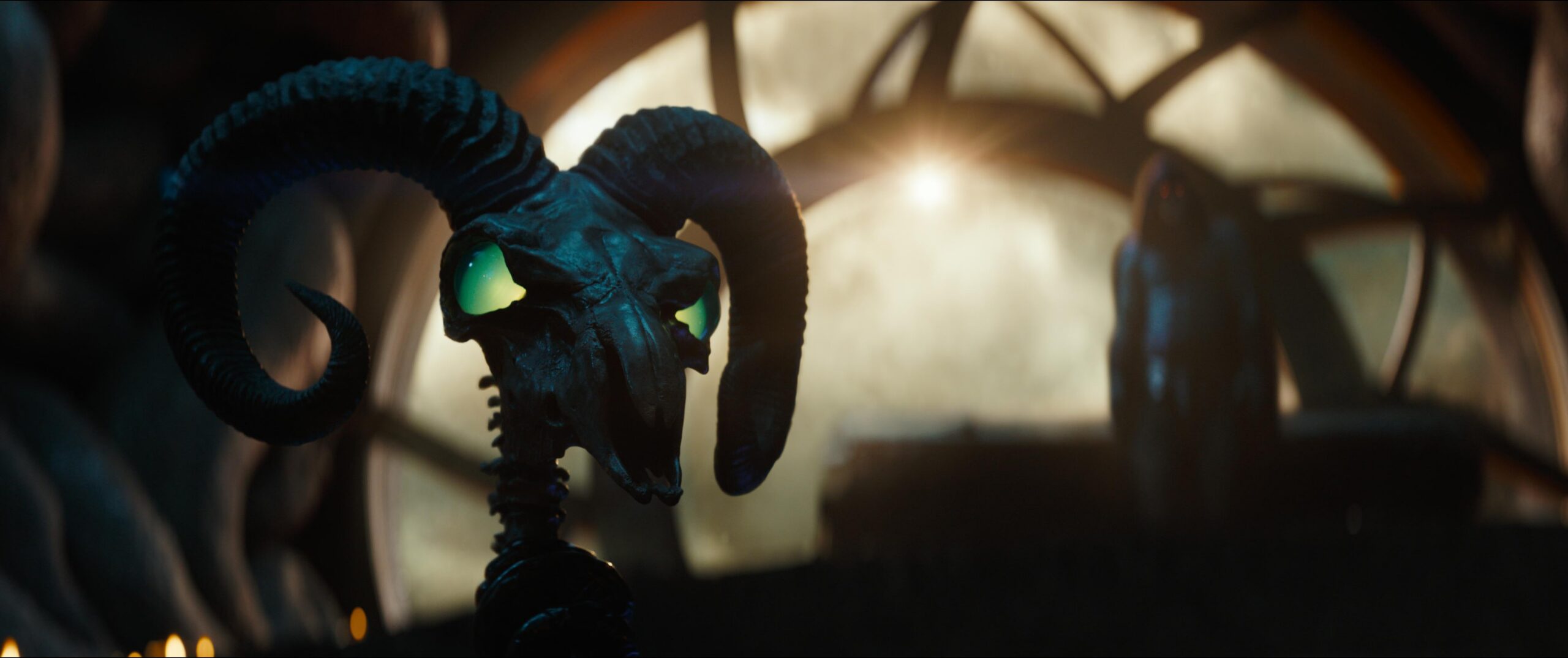
Within the subterranean depths of Snake Mountain, Pigboy is waking up his master, Skeletor, on a raised stone platform. The dark room is lined with stone snake carvings. Pigboy opens a large, iris-like window behind him using a mechanical contraption and light floods into the cave.
A partial green-screen set was filmed, with one sweeping curve of steps rising to the left side of the platform. Along with recreating a mirrored right sided staircase, the walls of the cave needed to be modelled and added to all shots.
To anchor the space, modelers utilized tracked cameras from on-set LIDAR scans to map out the room’s proportions and place proxy geometry for the window. Once the layout had been approved, the FX team generated the bodies of gargantuan, undulating snakes carved directly into the rock walls, focusing on the curvature of their intertwining forms. Individual snake heads were then added on a shot-by-shot basis, as though naturally emerging from behind the rocky architecture. Christian says, “This approach meant our clients had creative freedom to position and pose the snake heads on a shot by shot basis without us having to merge complex geometry together.”
For texturing, artists matched the volcanic rock characteristics of the practical walkways, adding custom wetness maps and specular reflections to amplify the damp, unpleasant atmosphere. The outside environment was finalized by integrating pre-rendered sky, cloud cycloramas and rocky terrain provided by ILM behind a newly added layer of dirty, scratched window glass.
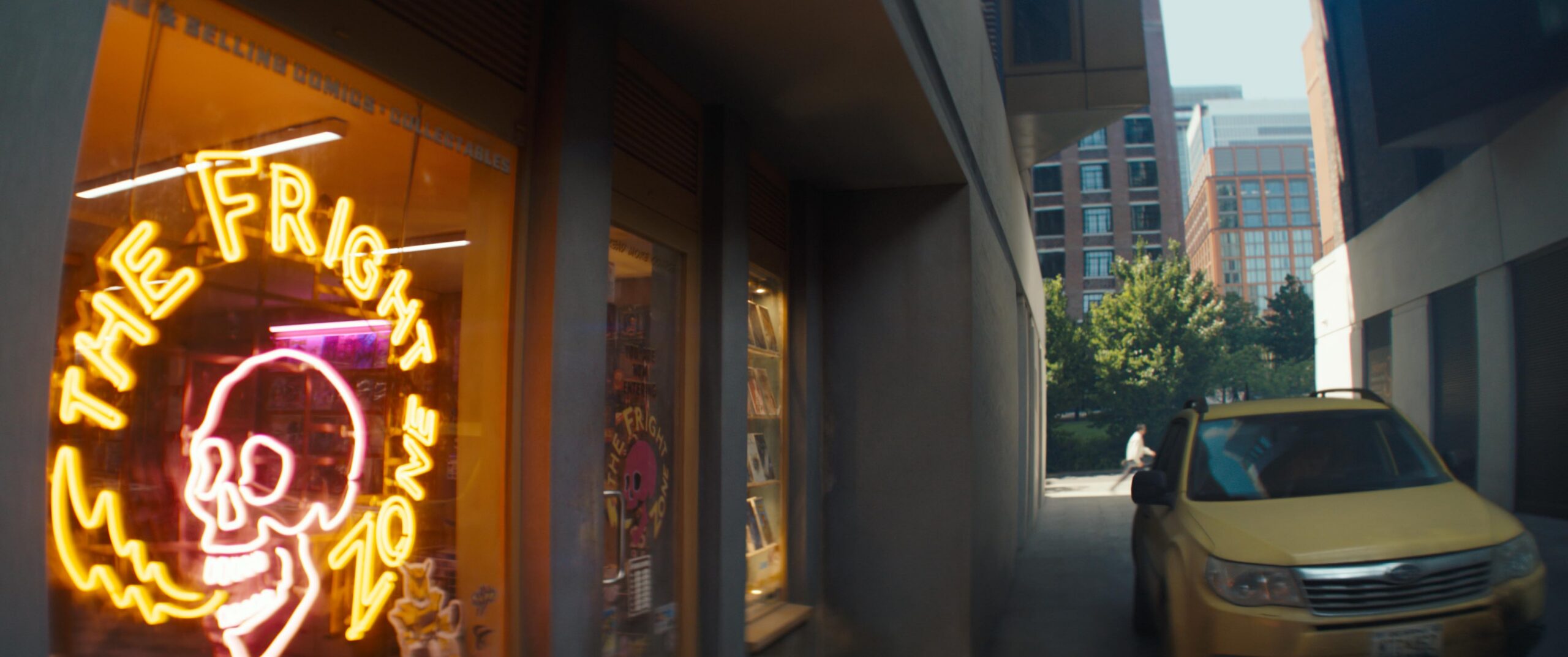 Beyond the large scale environments, Cinesite also lent our expertise to several other, narrative-driven effects, including a projected 3D hologram of the planet Eternia, character enhancements and a technically challenging shot near the beginning of the film, on Earth: Adam, pulls up his car outside a comic book and memorabilia shop. This deceptively simple shot required the integration of a non-motion-control plate of an alleyway shot in the UK (Plate A) with a studio plate of a car pulling up to a storefront (Plate B). The team projected Plate A onto simple geometry inside Nuke, extracted background cars and pedestrians onto 2.5D cards, and rebuilt the foreground architecture as a highly detailed digital matte painting to create a seamless Memphis street corner.
A huge thank you to our incredibly talented team of artists and production crew whose dedication, creativity and hard work truly brought the power to this epic project.